
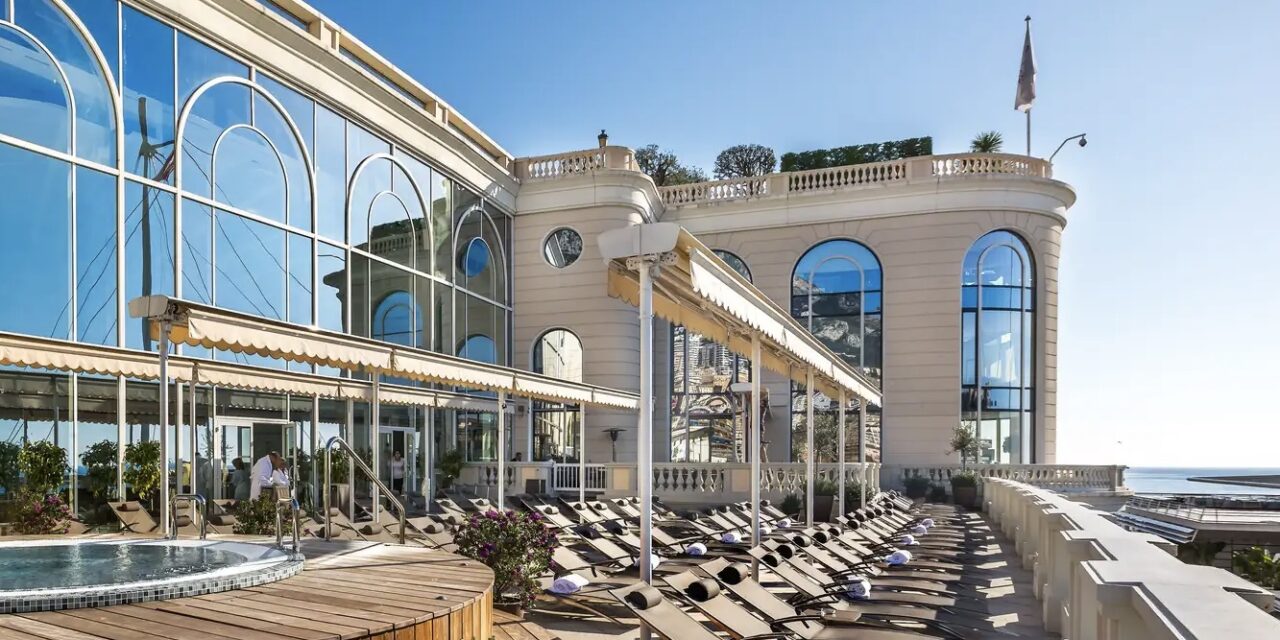
Monte-Carlo Société des Bains de Mer is preparing to tear down its ageing Thermes Marins spa complex entirely, replacing it with a vastly larger wellness and residential building as part of two major Monaco developments confirmed by the group’s President-Delegate, Stéphane Valeri, at a recent press conference.
The Thermes Marins, located near Avenue de Monte-Carlo, no longer meets European standards for a competitive spa offering, according to Valeri, prompting the group to demolish both the existing building and its neighbour, which housed Rothschild bank until the lender relocated near Place d’Armes in La Condamine this past July.
In their place, SBM plans to build a new roughly 13,000-square-metre complex, with 6,000 square metres dedicated to a high-end spa and 2,000 square metres given over to premium apartments on the upper floors.
Retail space comparable to brands like Hermès is planned on the opposite side of the avenue, alongside public gardens offering sweeping views, with existing surface parking relocated underground across three levels.
The scale of the project means the spa, pool and gym will close entirely for four years. To bridge that gap, SBM intends to shift wellness facilities elsewhere across its resort in the meantime, including a covered pool at the Hôtel de Paris for autumn and winter use.
A temporary pool, spa and gym will also be built on the Hermitage’s terrace above IM2S, a project Valeri said has already secured swift government approval and is due to begin in November, in time for the main works starting in October or November 2027.
He framed the long-term payoff in commercial terms, pointing to spa-driven tourism he had observed at competing resorts in remote parts of Switzerland as evidence of the revenue potential a modernised offering could unlock in Monaco. All permanent Thermes Marins staff will be redeployed elsewhere within the group.
Running alongside that project is a second, smaller expansion at the Monte-Carlo Bay hotel, where SBM plans to add three additional storeys, already agreed in principle with the government and requiring no changes to existing infrastructure.
Rather than new hotel rooms, the additional floor will house private apartments with pools and gardens, a decision Valeri tied directly to capacity limits already straining the resort’s shared spaces during peak summer months. Construction is expected to take three years, with completion targeted for 2030.
Both projects form part of a broader financial rationale within SBM’s wider strategy. Despite the group’s growing international ambitions, including a luxury hotel project in Courchevel and floating casinos aboard cruise ships, Valeri was clear that Monaco remains the group’s core priority.
Real estate currently accounts for just 1 percent of SBM’s total payroll, yet generated €156.5 million of the group’s €861.6 million revenue in the 2025/2026 financial year, around 18 percent of the total.
With its residential, retail and office space already fully let, Valeri said further growth in that segment will largely come from the roughly 3 percent rent increases already built into existing leases, rather than from expanding occupancy itself.