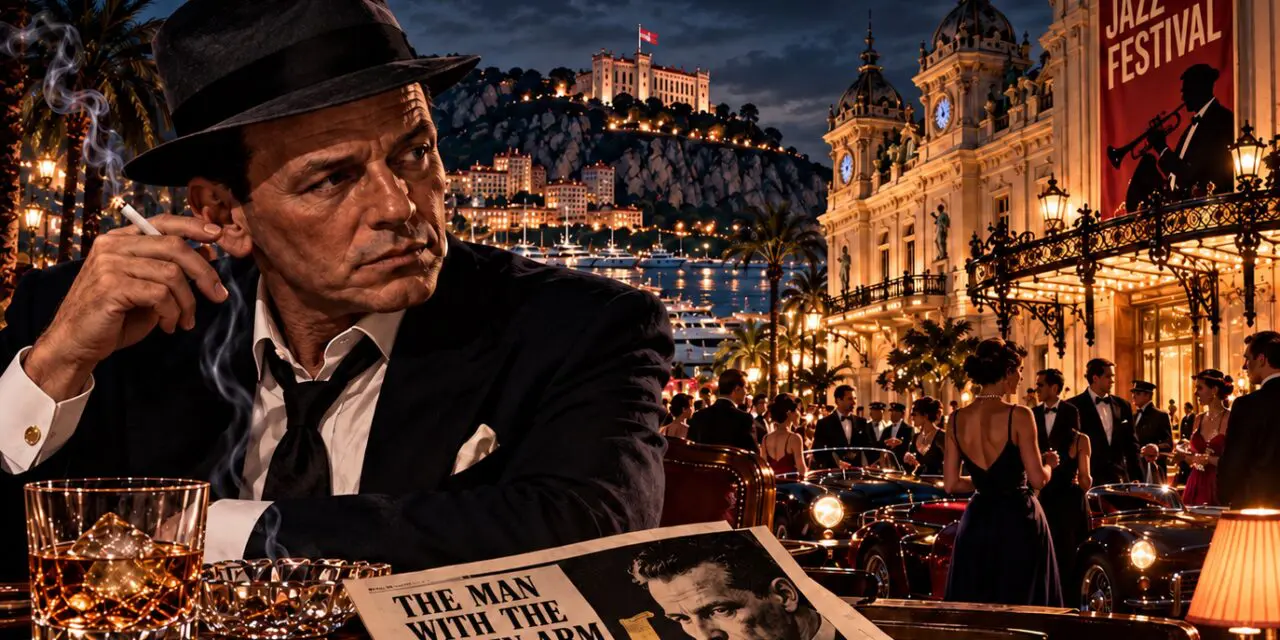
One of Frank Sinatra’s most stirring performances is his portrayal of Frankie Machine, the troubled protagonist of director Otto Preminger’s 1955 film The Man with the Golden Arm, adapted from Nelson Algren’s 1949 novel…
And now, more than seven decades later, the movie is coming to Monaco. The film will be screened at the Opéra Garnier on November 22, 2026, as part of the Monte-Carlo Jazz Festival’s 20th anniversary celebrations. Although The Man with the Golden Arm is a film primarily about drug addiction, it is also a film infused with jazz, cards, gambling, desperation and the possibility of trying to start life over again. A movie sui generis, if ever there was one.
Sinatra as drug-addicted former underground poker dealer Frankie Machine returns to Chicago after a spell in a rehabilitation centre. He wants to stay clean and reinvent himself as a jazz drummer. Unfortunately, addiction, the rapacious creditor, has other ideas. The horrors of gambling and drugs are central to the movie. The film shows the destructive, frightening and physically brutal side of addiction.
Good Morning Monaco ☀️
The day’s Monaco news in your inbox every morning. Free, unsubscribe anytime.
🔒 We won’t spam you or sell your data. Changed your mind? Unsubscribe with one click at the bottom of any email.
In 1955 however, simply showing such material on a cinema screen was itself an act of rebellion. The Motion Picture Production Code, better known as the Hays Code, had been strictly enforced since 1934. It laid down what was considered unacceptable content for motion pictures in America. Topics including addiction, gambling and cheating were considered taboo. Director Preminger however decided to challenge the Hays Code. The movie tackled a range of subjects which Hollywood had been expecting him to avoid. Preminger released the film as he wanted it released, with no compromises.
Yet for all its controversy, the film is also a remarkable piece of jazz cinema. Sinatra took the drumming seriously. The legendary jazz drummer Shelly Manne coached him for the film’s drumming sequences. Manne also played the drums on the soundtrack and appeared in the film as himself during an audition sequence. Jazz trumpeter Shorty Rogers also makes an on-screen cameo as a bandleader.
There was a specialist brought in to help with the card-playing sequences too. Legendary card magician Charlie Miller served as a technical adviser for the poker scenes. Miller was considered, in the world of card magic, to be an expert in sleight of hand, so he was a natural choice to help Sinatra make his card handling look convincing.
And then there is the soundtrack. Elmer Bernstein composed the celebrated, edgy jazz soundtrack, which became one of the film’s most distinctive features. It gives the movie a nervous energy that perfectly matches Frankie’s world. The film occupies an unusual place in cinema history. It is simultaneously a jazz film, a social drama, a gambling story and a direct challenge to Hollywood censorship.
But there is another reason the film’s story still resonates today and that is the notion of hope. Frankie Machine wants to escape his addiction. Now more than seven decades later, somebody struggling with a similar addiction has access to something Frankie did not have in 1955; a much wider network of recovery support.
For those struggling with addiction, Monaco has 12-step support meetings available, while a host of fellowships, including Narcotics Anonymous and Gamblers Anonymous, are available online. The world surrounding addiction has changed considerably since Preminger made his film. If the underlying struggles displayed on screen remain painfully familiar to some, there is some compensation in knowing that help and hope are in this era more readily available to all.
A Se Revede!
Websites listed are subject to change and for information purposes only. This list is not an endorsement:
Narcotics Anonymous https://na.org
Gamblers Anonymous https://gamblersanonymous.org
Alcoholics Anonymous https://alcoholics-anonymous.eu/meetings?tsml