
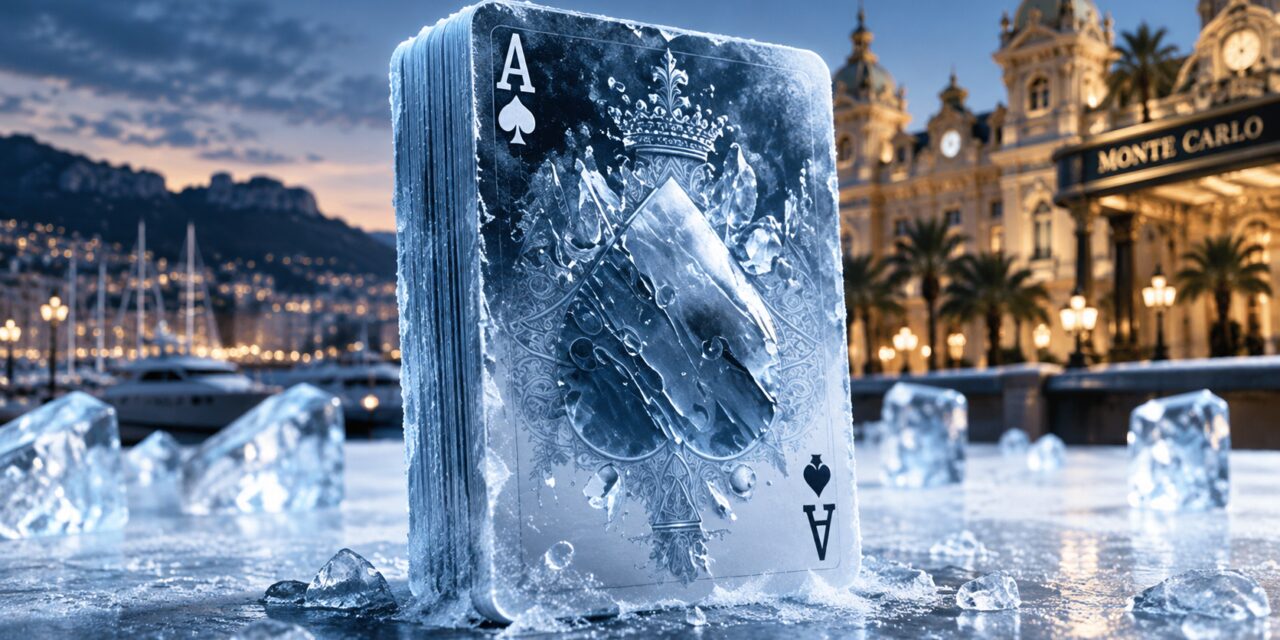
Mark Twain had a mischievous way of describing Monaco…
Writing in The New War-Scare, Twain stated that Monaco was bordered, “on the north by the Corniche turnpike, on the east by the railroad, on the south by the Mediterranean Sea, and on the west by the Cold Deck Factory…”
It was, of course, a joke…or at least an attempt at one. There was no literal factory in Monaco manufacturing packs of rigged playing cards. Twain was satirising Monte Carlo’s extraordinary association with gambling. But the expression “cold deck” was no invention. It was a real term from the world of card sharps. A card sharp, also commonly known as a card shark, is someone skilled at cheating at cards, using techniques ranging from sleight of hand and marked cards to secretly manipulating or switching the deck.
Good Morning Monaco ☀️
The day’s Monaco news in your inbox every morning. Free, unsubscribe anytime.
🔒 We won’t spam you or sell your data. Changed your mind? Unsubscribe with one click at the bottom of any email.
A cold deck was one of the most dangerous weapons available to a nineteenth-century card cheat: a complete pack of playing cards secretly prepared away from the gaming table, with pre-arranged hands and/or marked cards already built into its sequence. The cheat’s task was then to get the cards into a game.
So why the term ‘cold deck’ or ‘cooler’? During a legitimate game, a deck will feel warm from repeated handling. A deck newly introduced to a game would feel comparatively colder. Cold-decking became notorious in nineteenth-century American riverboat and saloon poker games and soon drifted to Europe.
The real danger was subtlety. A card sharp might pre-arrange a winning hand for himself, but not something as unlikely as a Royal Flush, which would draw attention. Instead, he might give himself four of a kind whilst dealing another player three kings, encouraging his victim to gamble big in the mistaken belief he held the strongest hand.
In modern poker language, an accidental clash between two extremely strong hands is often called a cooler. With a cold deck, however, that clash is anything but accidental.
Some of the clearest descriptions of cold-decking come from nineteenth-century gambling literature. George Devol’s Forty Years a Gambler on the Mississippi, published in 1887, drew on decades of experience as a professional gambler on the great American riverboats.
He describes bringing a cold deck into play: “We played a short time and on my deal I called their attention to something, and at the same time switched in the ‘cold deck.’” First comes the distraction, then the switch.
Koshitz’s Manual of Useful Information, published in 1894, also warned honest players about the methods used by card sharps. Intriguingly, it suggests the deck switch did not always have to be secret. A confederate serving drinks might ‘accidentally’ spill one over the legitimate cards, creating the perfect excuse to openly introduce the pre-tampered replacement deck.
Perhaps the most entertaining possibility was a card sharp accidentally cheating another card sharp. This inspired the old gambling gag of one player complaining that his opponent couldn’t possibly have four aces because “I’ve got them here”!
In the 1932 film Tillie and Gus, W.C. Fields’s character Augustus Q. Winterbottom gives a similarly dry account of a poker dispute: “I’m a broad-minded man, gents, but suspicious when a man lays down five aces in one hand… especially as I know that that’s not what I dealt him!”
The humour perfectly captures the absurdity of a cheat being irked that someone else’s cheating has interfered with his own. Twain’s imaginary “Cold Deck Factory” naturally makes the swindle sound inseparable from Monte Carlo and casino gambling.
But today, a private card game may be considerably more vulnerable to such tricks than a casino. Modern casinos are designed around control. Cards are supplied by the house, dealers follow established procedures and surveillance cameras monitor gameplay. Cards are inspected and controlled, whilst casinos may even change deck designs during an evening, rendering a pre-prepared substitute useless.
Casinos also monitor betting patterns to identify suspicious behaviour. Someone playing conservatively all night who suddenly starts betting carefree is sure to draw attention.
Monaco’s casinos therefore are amongst the safest places on planet Earth to make a fair bet.
As for private games away from the casino, well, if you do end up with 5 Aces in your hand, it’s probably time to take up a new hobby.
References:
· Twain, Mark. The New War-Scare. Passage referring satirically to Monaco’s “Cold Deck Factory”.
· Devol, George. (1887). Forty Years a Gambler on the Mississippi. Cincinnati: Robert Clarke & Co.
· McClintock & Koschitz. (1894). Koschitz’s Manual of Useful Information: Marks and Stamps, Portable and Fixed Devices, Manipulation of Cards. Kansas City, Missouri.
· Tillie and Gus. (1932). Paramount Pictures. W.C. Fields as Augustus Q. Winterbottom.