
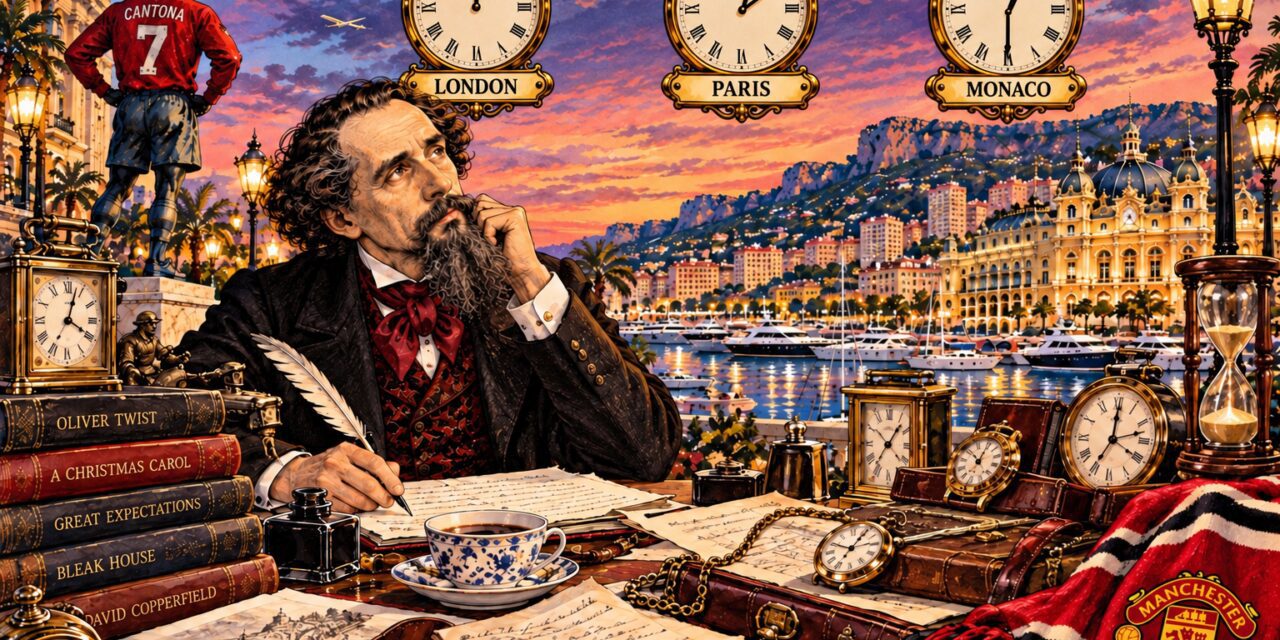
Charles Dickens travelled the maritime route bordering what is now the French Riviera in 1844–45, and recorded his experiences in Pictures from Italy…
Which got me thinking about time. Dickens is often colloquially credited with his own period of time, the Dickensian period; an expression used to describe the world of nineteenth-century Britain that Dickens portrayed so vividly. It isn’t technically an historical era, but it’s interesting that a writer became so associated with bygone time.
Has anybody else has managed that? Former Manchester United Manager Sir Alex Ferguson arguably did. In football, “Fergie Time” became the nickname for the additional minutes at the end of matches in which Manchester United seemed particularly capable of producing a late goal. Ferguson’s teams gained such a reputation for scoring late that the expression became part of football vocabulary.
Good Morning Monaco ☀️
The day’s Monaco news in your inbox every morning. Free, unsubscribe anytime.
🔒 We won’t spam you or sell your data. Changed your mind? Unsubscribe with one click at the bottom of any email.
Sir Alex himself even said that he used to point at his watch to unsettle opponents. Rival teams who criticise ‘Fergie Time’ are reminded that their team was still on the pitch playing the game during that time too, but they perhaps didn’t master the minutes as well as the canny Scotsman.
So Dickens has a time period, Ferguson made good use of the time at the end of games and Monaco, rather surprisingly, has had its own unique relationship with time.
Before 1 June 1892, Monaco had its own local mean solar time. Its clock was approximately 29 minutes and 32 seconds ahead of Greenwich London (GMT). Paris, meanwhile, was about 9 minutes and 21 seconds ahead of Greenwich. Then, on 1 June 1892, Monaco adopted the meridian of Paris. The two places were now operating on the same legal time. But that wasn’t the end of the story.
In March 1911, France finally brought its legal time into line with Greenwich, putting back Paris Mean Time by 9 minutes and 21 seconds. Monaco followed later that month, joining France, and effectively Greenwich, on the same time.
On February 25 1940, both Paris and Monaco moved forward to GMT+1, and to GMT+2 on 14 June. From 1942 onwards, they generally used GMT+1 in winter and GMT+2 in summer. Between 1946 and 1949, France and Monaco remained on GMT+1 throughout the year. Finally In 1949, they returned to GMT in winter, with GMT+1 during summer time. This arrangement continued until 1976. Since then, Monaco and France have used GMT+1 in winter and GMT+2 in summer, which remains the system today.
Aside from the history of time and its chopping and changing, communication around the topic has always faced linguistic complexities. It seems commonplace to hear the question: “Does anyone have the correct time?”. But why is it we need to specify that we want the ‘correct’ time. What reply are we expecting if we don’t specify our request? “Sorry, I’ve only got the incorrect time, but would you like that anyway?”.
Irish comedian Dave Allen summed up the oddities of time and how we struggle to express it when he observed in his ‘Teaching a child the time’ routine. “There are 24 hours in a day, 12 in the day and 12 in the night. That’s right, a day is made up of a day and a night”. A classic routine well worth checking out.
In the end, perhaps our obsession with managing time and its confusing definitions are just a symptom of our want to master the minutes, just like Sir Alex Ferguson on the touchline. We end on a sobering note that while we may argue over semantics and time zones, the clock keeps moving forward regardless. Benjamin Franklin captured that relentless truth perfectly when he warned: “You may delay, but time will not.”
A Se Revede!
References:
Charles Dickens – Pictures from Italy (1846)
Monaco legal time, 1892 and 1911 – IANA/Time Zone Database historical records, Journal de Monaco.
Benjamin Franklin – Poor Richard Improved, 1758.