
How can you tell if a car is registered in France or Monaco? The registration plates…
Those registered in France normally carry plates in the format AA-123-AA: letters, numbers, letters. Those registered in Monaco come in a few formats, but the most common generally uses just four numbers, e.g., 1264 or 0065. There are exceptions, as reported last week by news.mc regarding personalised plates, but today’s cautionary tale concerns the standard Monaco plate, which carries four numbers only.
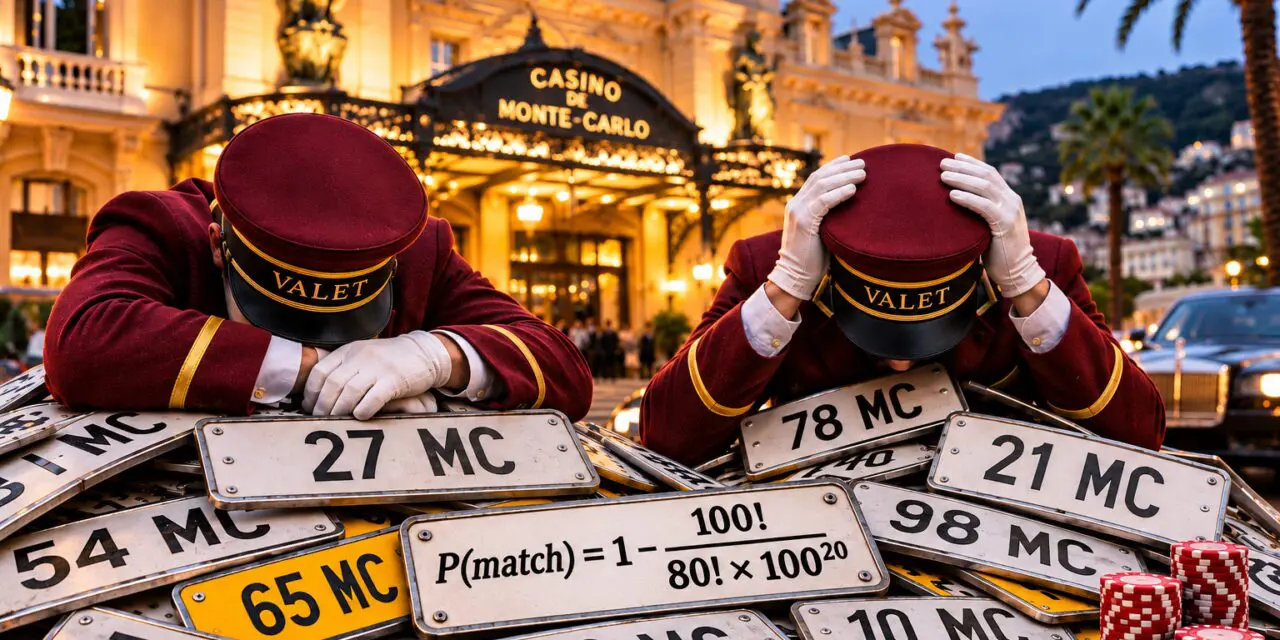
Two valets are standing outside a Monte Carlo casino, watching Monaco-registered cars arrive. Pierre turns to his colleague Giorgio. “Fancy a bet?” Giorgio looks suspiciously at him. Pierre points towards the road.
Good Morning Monaco ☀️
The day’s Monaco news in your inbox every morning. Free, unsubscribe anytime.
🔒 We won’t spam you or sell your data. Changed your mind? Unsubscribe with one click at the bottom of any email.
“Look at the next twenty Monaco-registered cars that arrive. I’ll bet that at least two of those twenty cars will have exactly the same first two numbers on their licence plates, in exactly the same order. For me to win, if one car begins with, say, 37, another must also begin with 37.”
Giorgio glances at the traffic and asks, “So you’re betting that somewhere amongst the next twenty cars, two cars will have the same two starting numbers?” Pierre replied: “Exactly.”
Giorgio doubts that if he sees a car with a plate starting with, say, 82, another car with a plate starting with 82 will appear amongst the other 19 cars. He believes a match is unlikely, so he’ll probably win the bet. “I don’t think there will be a match, so I’m taking the bet,” says Giorgio. They shake hands.
Before reading on, would you take the bet? Are you with Pierre or Giorgio? On with the tale…
The first Monaco-registered car approaches. Its plate begins with 64. Giorgio glances at Pierre. “Sixty-four,” he says. Pierre makes a note. The second car arrives: 18. Giorgio smiles. The third: 52. No matches. It’s going well for Giorgio. The fourth: 91. The fifth: 07.
Giorgio is beginning to enjoy himself. Not long now, he thinks, before he is collecting his wager from Pierre. No car of the five cars that have arrived has a matching first two numbers with one of the other cars that has arrived.
“Easy money,” Giorgio says. Then comes the sixth car. Its plate begins with 52. Giorgio stops smiling. Pierre looks at him. Giorgio compares the third and sixth cars. Both began with ‘52’. The same two numbers, in exactly the same order.
Bet over. Pierre wins. “But I lost within just six cars. It’s almost impossible!” Giorgio whimpers. Giorgio looks genuinely puzzled. He was certain the odds were in his favour. In fact, he was highly likely to lose, as indeed he did.
So what’s really going on? Why was what seemed to be an almost certain winning bet actually an almost certain losing proposition? Giorgio’s intuition was understandable, but he overlooked something. Giorgio was looking at the odds of a specific match, whereas Pierre was looking at the odds of any match.
With 100 possible combinations (00–99), the chance of any other individual car having the same combination as a particular car is only 1 in 100. That sounded unlikely, prompting Giorgio to accept the bet. But Pierre knew that any of the 100 combinations could be repeated for a match. The second car could match the first, the third either of the first two, the fourth any of the first three, and so on. Every arrival offered another chance of a match, which could occur anywhere amongst the twenty cars.
Regarding probability, that changes everything. Assuming all 100 possible combinations are equally likely, the probability that two or more of the twenty cars share the first two numbers on their registration plates is approximately 86.96 percent.
It’s more likely than unlikely, as a shocked Giorgio discovered. Luckily, Monaco’s law prohibits games of chance in public places, so Giorgio never had to pay up. So the moral of the story is, stay away from illegal gambling and bets that sound too good to be true.
There’s no such thing as free money, especially when it’s offered to you on a plate.
A Se Revede!
References:
Games of chance in public: Monaco’s Ordonnance Souveraine 11 Juillet 1909, Article 72.