
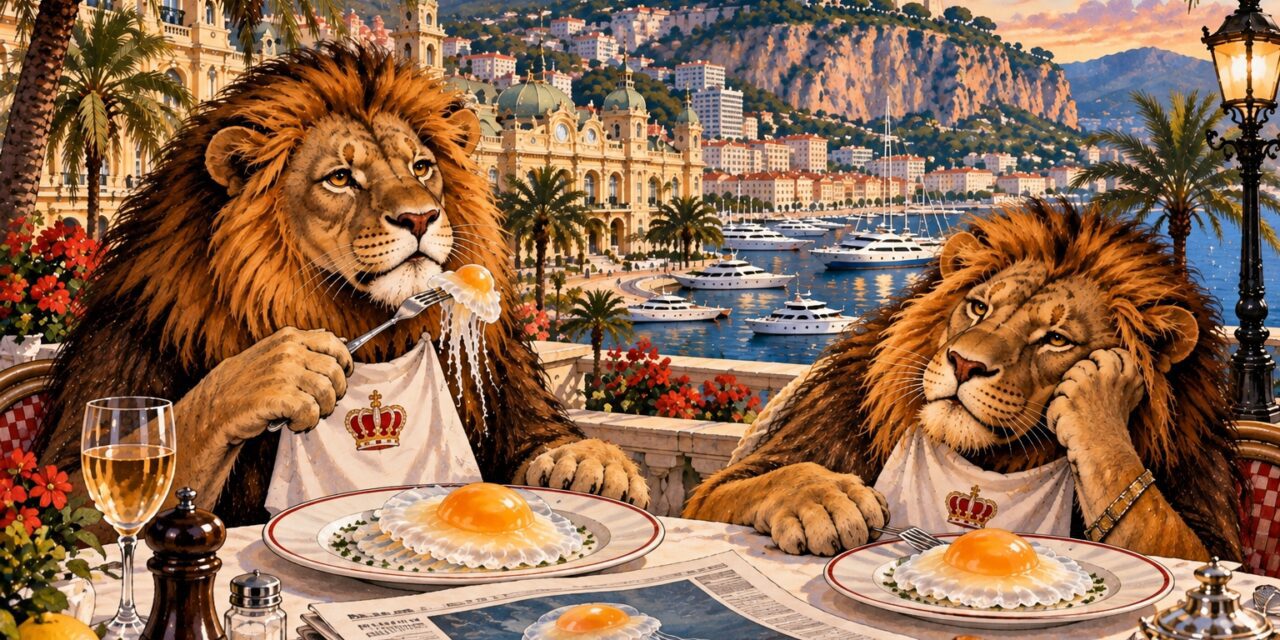
Fried eggs are often blamed for being bad for your health. Too much oil, too much cholesterol, so perhaps not the ideal choice for every breakfast. But this is not a warning about the food on your plate…
This is a cautionary tale, or perhaps, more accurately, an introduction, to a very different kind of fried egg: the fried egg jellyfish. Floating beneath the beautiful waters of the Mediterranean, including those around Monaco, this unusual creature looks almost as if someone has dropped a fried egg into the sea. Its rounded white body and raised yellow-orange centre give it the appearance of a giant fried egg drifting through the water.
Its scientific name is Cotylorhiza tuberculata, and it is one of the more recognisable jellyfish species found in the Mediterranean. Unlike some jellyfish that are feared because of their painful stings, the fried egg jellyfish is generally considered to be relatively harmless to humans.
Good Morning Monaco ☀️
The day's Monaco news in your inbox every morning. Free, unsubscribe anytime.
The fried egg jellyfish prefers warm, calm waters and is often seen near the surface. It is carried by ocean currents and can sometimes appear in groups, particularly during the warmer months. These gatherings are known as blooms and are a natural phenomenon.
As with all wildlife, however, jellyfish should be treated with respect. The simplest advice is not to touch them. Even species regarded as relatively harmless can cause irritation, and everyone may react differently to a sting. If you come across jellyfish while swimming, it is sensible to give them plenty of space rather than attempting to swim through them.
If you would like to know whether jellyfish have recently been reported to be in the area, a number of websites and smartphone apps now allow scientists, marine organisations and members of the public to record sightings around the Mediterranean. These can provide a useful indication of recent activity before heading to the beach.
Monaco’s jellyfish also provide an intriguing literary connection. More than a century ago, Sir Arthur Conan Doyle visited Monte Carlo during a tour of the French Riviera. A number of years later, he wrote the Sherlock Holmes story The Adventure of the Lion’s Mane, in which Holmes investigates a mysterious death eventually traced not to a murderer, but to the sting of a Lion’s Mane jellyfish. Although the Lion’s Mane is a very different species from Monaco’s fried egg jellyfish, both demonstrate how the sea has long inspired mystery, curiosity and has even been the inspiration to give some species odd names. How influenced Conan Doyle was to build a story around strangely named jellyfish after leaving Monaco we will never know.
One gentle reminder: this article is intended as general information only. If you are unfortunate enough to be stung by a jellyfish, or experience any worrying symptoms after entering the sea, always seek appropriate professional medical advice.
As a rule of thumb, I tend to steer clear of anything related to lions. I only wish I could say the same thing about fried eggs!
A Se Revede!
Further Reading:
Readers interested in Sherlock Holmes may enjoy The Adventure of the Lion’s Mane, first published in 1926 and later included in The Case-Book of Sherlock Holmes (1927).
For those wishing to monitor jellyfish activity around Mediterranean beaches, www.meduseo.com provides maps of reported jellyfish sightings submitted by scientists and members of the public. This mention should not be regarded as a specific endorsement of the service.