Monaco has called for the development of a responsible, equitable and internationally governed lunar economy, as the Principality highlighted its contribution to future Moon exploration at the 77th International Astronautical Congress in Antalya, Türkiye.
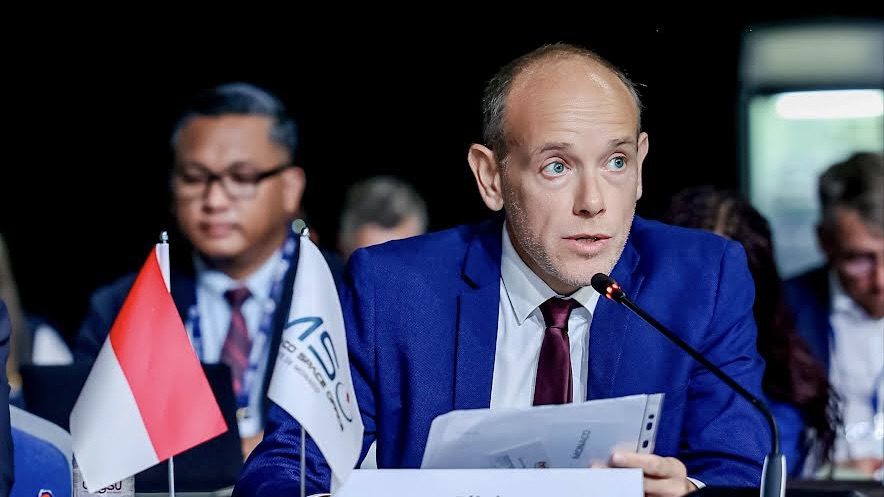
Representing Monaco at the International Astronautical Federation’s Global Space Leaders Summit, Olivier Minazzoli, Administrator of the Princely Government’s Office of Space Affairs, outlined the role of Monaco’s space industry in developing lunar mobility technologies and stressed the need for international cooperation as commercial activity on the Moon advances.
The high-level summit brought together leaders and senior representatives from space agencies around the world to discuss global challenges, strategic opportunities and the principles needed to ensure responsible governance of the space sector.
Good Morning Monaco ☀️
The day's Monaco news in your inbox every morning. Free, unsubscribe anytime.
Speaking during a panel entitled “Lunar Economy: Building Humanity’s Next Frontier”, Minazzoli said the return to the Moon was no longer solely a scientific undertaking, but was increasingly becoming an economic and industrial project.
The question, he argued, was no longer simply whether a lunar economy would emerge, but how it would be developed and which principles would govern its activities.
Monaco’s contribution to this emerging sector is already taking shape through Venturi Space, which operates in Monaco and Europe and develops technologies designed to support lunar mobility.
The company’s high-performance batteries are set to equip the FLIP rover developed by American company Astrolab, which is expected to launch towards the Moon’s south pole by the end of 2026. Astrolab’s CLV-1 vehicle, derived from Venturi Space’s FLEX architecture, has also been selected by NASA as part of its lunar mobility systems.
Venturi Space is additionally contributing to the development of European lunar mobility capabilities through the MONA LUNA and ALTA LUNA rovers.
Alongside these technological developments, Monaco used the summit to emphasise the importance of establishing clear international principles for the future exploitation of lunar resources.
The Principality argued that the use of the Moon’s resources must not become a means of territorial appropriation or exclusion, insisting that exploration and economic activity should respect international law and contribute to the common good.
Monaco also stressed the importance of preserving the Moon’s scientific value and heritage, while ensuring that the opportunities and benefits generated by lunar activities are not reserved for a limited number of countries or private operators.
The Principality’s position places multilateral cooperation at the centre of future lunar governance, with Monaco arguing that the rules governing this emerging economy should be developed through international dialogue rather than unilateral action.
Concluding its intervention, Monaco outlined a vision in which technological innovation and industrial development go hand in hand with collective responsibility.
“A lunar economy will only be sustainable if it is also legitimate and trustworthy,” the Principality stated, adding that the ambition should not simply be to build an economy on the Moon, but to create one that is “innovative, responsible, equitable and open to those who will come after us”.
The intervention highlights Monaco’s growing involvement in the space sector, combining the development of advanced technologies with calls for international cooperation as humanity prepares for a new phase of lunar exploration.
Image courtesy of the International Astronautical Federation: Olivier Minazzoli, Administrator of the Office of Space Affairs, speaking at the IAF Global Space Leaders Summit, held as part of IAC 2026 in Antalya