
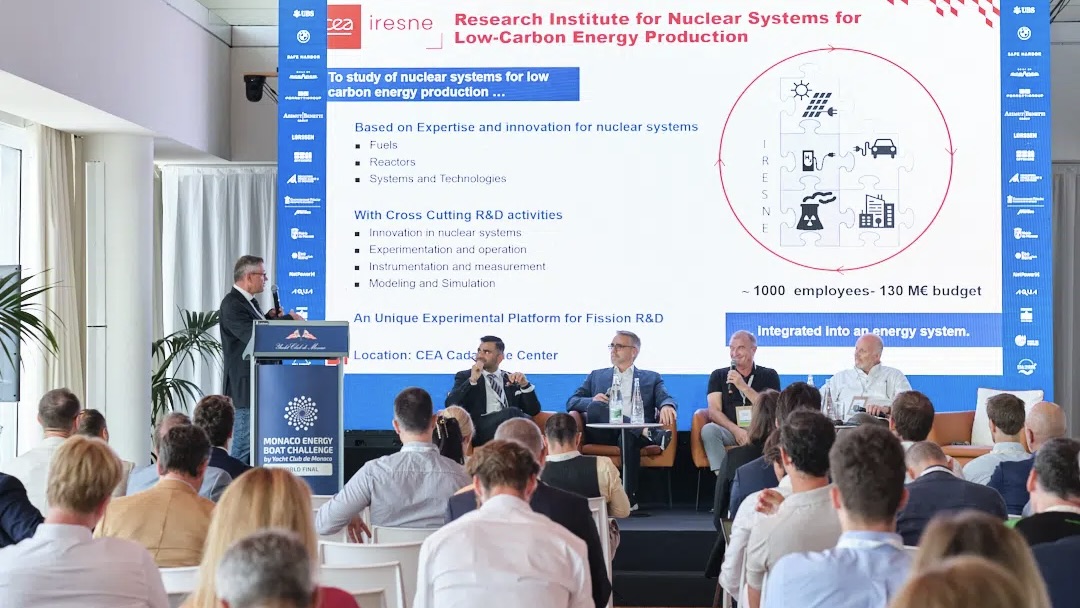
Industry leaders, researchers and shipbuilders gathered at the Yacht Club de Monaco on Friday, July 10, for the 7th Alternative Fuels Conference, organised jointly by YCM and the Prince Albert II of Monaco Foundation as part of the 13th Monaco Energy Boat Challenge. The event delivered a clear consensus: no single fuel will decarbonise the maritime sector alone. Instead, hydrogen, methanol, batteries, wind propulsion and even nuclear power are expected to coexist, each suited to different vessel types and operational needs.
Opening the event, Salomé Mormentyn, Polar Initiative Manager at the Prince Albert II of Monaco Foundation, said the debate had evolved beyond searching for one dominant solution, stressing instead the need to test and compare technologies to determine how each can be realistically deployed.
On hydrogen, John Rossant, President of the Monaco Hydrogen Alliance, argued that Europe has a narrow window to lead on hydrogen-derived fuels while other regions slow their investment. He described hydrogen not as a standalone option but as the underlying molecule behind most future maritime fuels. Speakers agreed the technology itself is largely ready, with the real challenge now centred on infrastructure, production capacity and the investment needed for large-scale rollout. Pierre Ceccaldi of Capenergies noted that fuel choice increasingly depends on supply chain maturity and logistics as much as technical performance, while Marco Galimberti of NatPower H detailed his company’s continued investment in hydrogen production and distribution networks alongside Italian port authorities. Andrea Porrini of Linde offered a note of caution, saying every hydrogen investment now requires careful cost-benefit analysis.
Good Morning Monaco ☀️
The day's Monaco news in your inbox every morning. Free, unsubscribe anytime.
Nuclear power featured prominently for the first time at the conference. Jean-Michel Ruggieri of the CEA’s IRESNE Institute outlined research into small modular reactors for maritime use, covering land-based, offshore and eventually onboard applications, but noted that establishing an international regulatory framework remains the primary obstacle rather than the technology itself. Derek Munro of Yacht Consultancy Ltd, whose company has spent five years developing compact reactor technology for yachts starting at 45 metres, predicted nuclear-powered vessels could appear by 2030. Aakash Dua of DNV and Engel Jan de Boer of Lloyd’s Register both framed nuclear as one part of a broader energy mix, with de Boer noting the remaining hurdles are societal and economic rather than technical.
Wind propulsion also re-emerged as a serious contributor to the energy mix, no longer viewed in isolation but as a complement to electric and alternative-fuel systems. Martina Reche-Vilanova of North Windships pointed to emissions reduction, fuel savings and automation as the key drivers behind its resurgence, while Jean Guyon of Aeroforce described automated rigid sails as a fuel-free energy source on a par with batteries or solar. Carlo Torre of MYT Group added that wind systems now need to match the comfort expectations of motor yacht owners in order to gain wider market acceptance.
Methanol was presented as one of the most advanced solutions currently available, already powering more than 400 vessels worldwide. Ernesto La Colla of Feadship noted that operational use accounts for roughly 94 percent of a yacht’s carbon footprint, making fuel and propulsion the clear priority. Simone Bruckner of Sanlorenzo said the technology itself has matured, though green methanol remains scarce in the Mediterranean. Engine manufacturers including Rolls-Royce Power Systems France and Everllence SE confirmed their methanol engines are technically ready, with hybrid, multi-fuel architectures now seen as the most realistic near-term approach.
Batteries, meanwhile, were described across the conference as the connective tissue of hybrid energy systems. Stéphane Jardin of EODev said batteries remain essential regardless of which primary technology is chosen, while Laura Langh-Lagerlöf of Langh Tech highlighted new European rules pushing commercial vessels toward electrification in port. Tuomo Salmi of Corvus Energy pointed to proven safety, improving energy density and cost as reasons for batteries’ widespread adoption, while Daniele Bottino of ABS noted their relative simplicity compared with other emerging fuels. Safety, particularly around thermal runaway prevention, remained a key theme throughout the discussion, alongside the continued gap in high-power charging infrastructure.
Taken together, the conference reinforced a broader shift in thinking across the yachting and maritime industries: rather than betting on a single fuel of the future, the sector is increasingly building toward a hybrid model in which hydrogen, methanol, batteries, wind and nuclear power each play a complementary role.
More Monaco news
 Monaco Yacht Show to expand to Saudi Arabia with new Red Sea Yacht Show
 Benetti’s hybrid yacht Dagger receives SEA Index certification in Monaco
 €2 Billion Ulyssia: World’s largest residential yacht confirmed in Monaco
 Monaco Yacht Show opens with 43 world premieres across a 120-strong superyacht fleet