As Halloween approaches, so do tales of vampires. Is there any truth, though, to these seasonal fables, or is it all just folklore..?
The Riviera already has nocturnal inhabitants. The Molosse de Cestoni is one of Europe’s largest bats and resides in Nice, which is just 20km from Monaco as the crow (or bat) flies. But after dark in Monaco, with the sound of fluttering above the rooftops, sometimes the mind can play tricks. Are they bats or something else? Vampires perhaps? Vampires aren’t real, are they?
Before Dracula reportedly arrived in Transylvania, vampires were already causing trouble in Europe. In 1725, in the Serbian village of Kisiljevo, a man called Petar Blagojevic died, followed later by nine others. Just before the nine others died, they claimed that Blagojevic, despite already being dead, had attacked them.
Good Morning Monaco ☀️
The day’s Monaco news in your inbox every morning. Free, unsubscribe anytime.
🔒 We won’t spam you or sell your data. Changed your mind? Unsubscribe with one click at the bottom of any email.
His grave was opened. The official report described a corpse that appeared strangely well preserved, with hair and nails apparently having grown since his death, while fresh blood was smeared around his mouth. This caused suspicion, so the body was then exhumed, staked and burned. The account was published in the Wienerisches Diarium in July 1725 and helped spread the vampire story far beyond Serbia.
Serbian Professor Nemanja Glintic of Guangdong University of Foreign Studies teaches a course that covers the history of South Slavic folklore, which includes the topic of vampires. Here he shines some light on these creatures of the night: “When it comes to the origins of vampires, people tend to think of Transylvania, but the story of the vampire actually has deep roots in Serbia. Petar Blagojevic is one of the earliest documented Serbian vampires. His case is particularly important because accounts of his alleged vampirism in the village of Kisiljevo appeared in the 18th-century Austrian press, helping to spread the Serbian word Vampire/Vampir (вампир) across Europe”.
“Blagojevic may have been one of the earliest recorded vampires, but in Serbia he is certainly not the most famous one. That title belongs to Sava Savanovic of Zarozje village. The story of Sava Savanovic, written by Milovan Glisic, was published 17 years before Bram Stoker’s Dracula. It was later adapted into the 1973 Serbian horror film She-Butterfly (Leptirica).
“What makes Serbian vampire folklore so interesting is how different it is from the modern portrayal of vampires, as not only deadly but also charming and sophisticated. In Serbia, traditional accounts describe vampires as anything but attractive. One striking detail is that they were said to have thick body hair like a werewolf, and South Slavic folktales often described them as bloated, with flushed faces from drinking so much blood. These folk tales are a long way from the handsome Hollywood vampire we often see on our screens today.
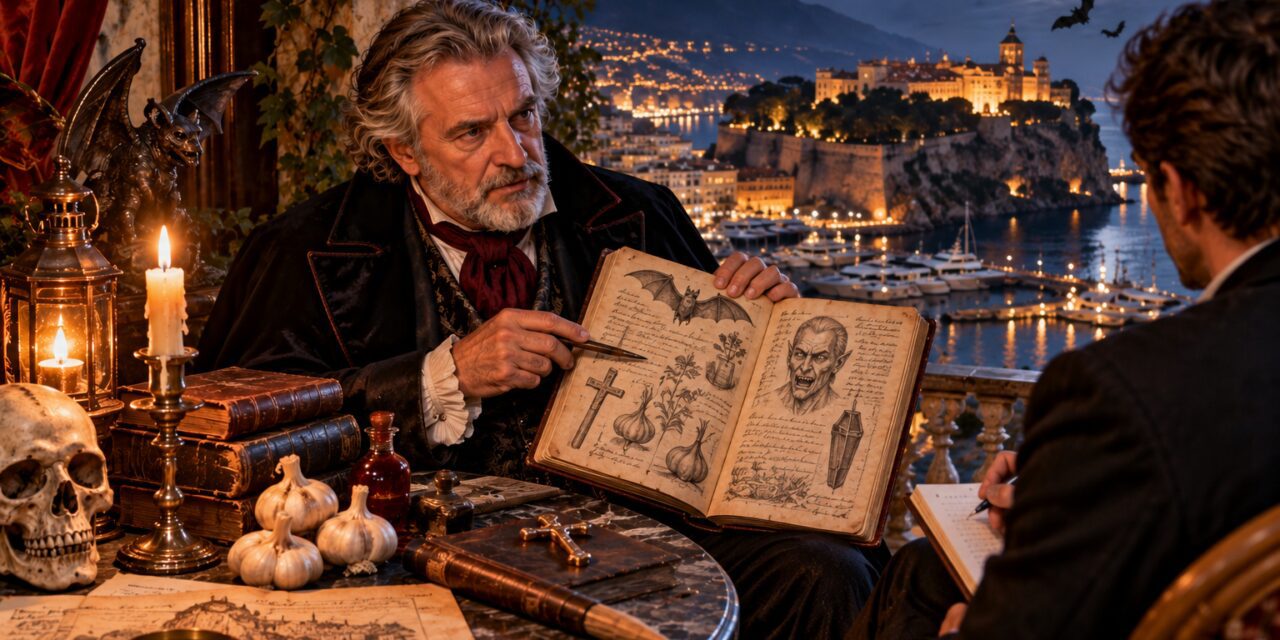
“Monaco is quite far from Serbia, though, so don’t worry about any nocturnal visitors this Halloween. And if vampires really did head that way, there are plenty of traditional natural barriers halting their progress. Garlic and Hawthorn both grow locally to the Riviera region. They serve as a solid line of defence to prevent vampires visiting. In literature, both have long been regarded as effective deterrents.
“One point of interest is that Monaco is approximately 666 miles from the outskirts of ‘vampire’ Petar Blagojevic’s hometown, Kisiljevo in Serbia. 666 is, of course, a spooky number, but let’s just put it down to coincidence. Stock up on garlic and you’ll be OK. I will conclude by saying to the good people of Monaco: fear not this Halloween; Monaco is safe from vampires, so enjoy the festival, and, as we say in Serbia, ‘Спавајте (с)покојно’.“
Thanks to Professor Glintic for his reassuring and informative words.
Head to the Marché de La Condamine at Place d’Armes to stock up on garlic if so desired. And I can confirm with confidence that garlic works as a deterrent because I’ve been eating it all my life and I’ve not once seen a vampire.
Happy Halloween
A Se Revede!
References:
Summers, Montague. The Vampire in His Natural History. K. Paul, Trench, Trubner & Co., 1928
Paul Greene 2026 Interview with Professor Nemanja Glintic, Guangdong University of Foreign Studies (nemanjamglintic@gmail.com)