
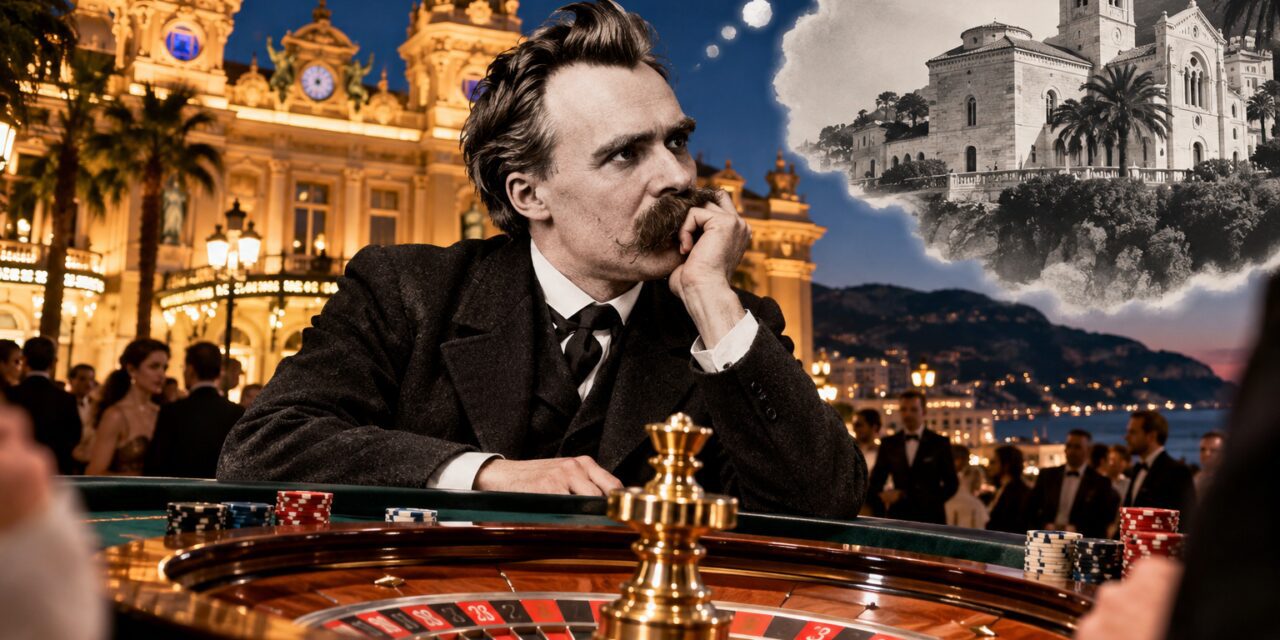
Monaco has had its fair share of interesting visitors over the years. In early March 1882, Friedrich Nietzsche made a short trip to Monte-Carlo, accompanying his friend Paul Rée to the iconic Monte Carlo Casino…
Friedrich Nietzsche (1844–1900) was a German philosopher and cultural critic whose radical ideas deeply shaped modern thought, existentialism, and psychology. The philosopher insisted, though, that he never placed a single roulette bet, framing himself only as a neutral observer dissecting human behaviour.
It is an all-too-familiar excuse that almost every person has used. We “doth protest too much” and tell partners we were “just watching” after a reckless night of gambling, claiming we held no stake in the chaos unfolding around us. Nietzsche’s claim reads less like scholarly discipline and more like a classic case of denial. Perhaps saying nothing would have drawn less attention to what he was doing. Perhaps I am projecting. Perhaps.
Within the casino’s glitzy halls, we can ask; “Was Nietzsche witnessing a vivid display of modern nihilism?”. Was he seeing crowds of visitors surrendering their free will to the spin of a wheel, chasing fleeting wealth and luck to manufacture meaning in their lives? We don’t know, but through the lens of Nietzsche’s philosophy, it is certainly an entertaining question to ask.
Around the time of his Monaco visit, Nietzsche penned his iconic declaration: “God is dead?” The statement proclaimed the perceived collapse of traditional religious meaning, leaving humanity tasked with building purpose entirely from within themselves. Yet a question arises: what if Nietzsche had strayed from the casino floor to explore Monaco’s quiet historic churches? If he had spent significant time and focus there, would he have penned the same declaration?
He critiqued humanity’s desperate search for purpose yet on this trip he seemed to limit his observation to the most trivial of pursuits; that of gambling.
Nietzsche’s core doctrine holds that true meaning cannot come from divine scripture or random chance, it must be forged through individual will and resilience. Still, his narrow focus on Monaco’s gaming rooms, over its buildings of faith, creates a striking imbalance. Did he judge the death of universal meaning after witnessing the gaming tables?
Ultimately, for most, there is nothing wrong or overly deep with a casual flutter at the casino. The weight of universal meaning is not hanging upon a spin at the table. It can be just good fun.
Naturally, his grand thesis was built on years of academic study, not a weekend trip, but the geographical overlap is too tempting to ignore. There’s no straw man argument in flow here, just a lighthearted observation that for Nietzsche to make such a sweeping judgement about the foundations of meaning, perhaps he needed to take more than a quick peek inside a casino.
Did his trip to Monaco give birth to his thoughts or cement what was already growing in his mind? “God is dead”; a big statement indeed, but as some may counter, those who have the least to say, are often the ones who say it the loudest.
A Se Revede!
References:
Nietzsche’s 1882 Monte Carlo casino visit: Verified in Nietzsche’s collected personal correspondence (KSB 6, No. 195), documenting his short trip with Paul Rée and his non-participatory observational stance at the roulette tables.
“God is dead” thesis: Friedrich Nietzsche, The Joyful Wisdom (1882), Section 125 (The Madman).