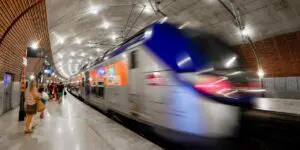
A proposed €5.8 billion underground railway linking Nice Airport with Monaco and potentially extending to the Italian border is back in the spotlight, despite having been dismissed by France’s Transport Minister last year.
Philippe Ortelli, president of the Federation of Monegasque Businesses (FEDEM), is renewing his call for the project, arguing that the region needs a major transport solution to support Monaco’s growing workforce and ease pressure on increasingly congested roads and rail services.
The idea is not new. FEDEM has been promoting a cross-border metro for several years, with earlier plans presented in September 2025. However, the proposal suffered a major setback in November that year when French Transport Minister Philippe Tabarot described the connection as unrealistic, citing its financial cost and the difficulties of building through the densely populated coastal landscape.
Good Morning Monaco ☀️
The day’s Monaco news in your inbox every morning. Free, unsubscribe anytime.
🔒 We won’t spam you or sell your data. Changed your mind? Unsubscribe with one click at the bottom of any email.
Since then, the project has continued to attract interest from local representatives. Nice Mayor Éric Ciotti has committed to examining the possibility, while officials in Menton and Ventimiglia have also shown support. FEDEM is now presenting a more developed proposal, based on a 14-station route and a projected investment of between €5.6 billion and €5.8 billion.
The proposed automated service would connect Nice Airport to Monaco in approximately 23 minutes. For passengers travelling from eastern Nice, the journey to the Principality is estimated at around 11 minutes. Trains would run every five minutes during peak periods, with the service intended to operate throughout the day and night.
The proposed route would begin at Nice Airport before serving the Allianz Riviera stadium and the Saint-Isidore logistics and business district. It would then continue underground through northern and eastern Nice, including connections with the existing tram network, before heading towards Èze and Monaco.
Five stations are envisaged within the Principality, serving the hospital, Sainte-Dévote railway station, the area around the tourist office, Place des Moulins and Larvotto. The route would then continue towards Menton, with a stop at Carnolès and the possibility of extending the line to Ventimiglia in Italy.
Much of the railway would be underground, although the section between the airport and the Allianz Riviera would follow the Var valley alongside the motorway. Ortelli argues that this approach would avoid many of the disruption and land acquisition problems associated with major surface railway projects.
For Monaco, the principal argument is economic. The Principality currently has approximately 60,000 employees, a figure that could rise to 100,000 by 2070. Around 17,000 people from Nice already commute to Monaco for work each day.
Ortelli believes the proposed metro could remove as many as 10,000 cars from the roads daily, reducing congestion on the A8 motorway and the coastal routes. He also argues that more reliable connections would make employment in Monaco more attractive to workers living across the wider Alpes-Maritimes region.
The proposed system would be fully automated, with platform safety doors and no onboard driving staff. Its supporters also envisage using the network for overnight freight movements, transporting goods from the Saint-Isidore logistics centre towards Monaco.
Reliability is another central part of the argument. Existing rail services can be disrupted by accidents, industrial action and extreme weather, while road journeys are vulnerable to congestion. Ortelli believes a largely underground system would provide a more dependable alternative, particularly as climate change increases the risk of severe weather events.
The financial challenge, however, remains substantial. FEDEM’s assessment, prepared with engineering consultancy Lombardi, estimates the cost at between €5.6 billion and €5.8 billion using construction prices associated with major contractors Eiffage and Vinci.
The proposed financing structure would combine around €1 billion in private investment, a further €1 billion from European funding and public grants, market borrowing of approximately €2.3 billion and public investment of around €1.5 billion.
Ortelli says private investors in Monaco have already expressed interest, with some potentially prepared to contribute between €10 million and €50 million. He believes the project could become profitable over a 70-year period, although the financing arrangements have not been secured.
The timetable would also be lengthy. The current estimate allows for around ten years of studies and ten years of construction. A public-private partnership could potentially bring the overall period down to approximately 15 years.
While the metro remains a long-term ambition, FEDEM is also proposing a smaller road project that could be delivered sooner. The organisation has suggested extending Monaco’s uphill tunnel by approximately one kilometre towards the Tête de Chien, at an estimated cost of €100 million.
The proposed extension would emerge near the Pastor depot area between Èze and La Turbie. Ortelli believes it could help reduce evening congestion around Cap-d’Ail by improving the flow of vehicles leaving the Principality. He estimates that the work could be completed within two to three years.
Despite renewed political interest and a more detailed technical and financial proposal, the Nice–Monaco–Ventimiglia metro has not received formal approval. Its future depends on further studies, agreement between the authorities involved and the ability to secure billions of euros in investment.
For FEDEM, the argument is that Monaco’s future economic growth cannot be separated from the transport infrastructure connecting it to the neighbouring towns and communities that supply much of its workforce. Whether the latest proposal can overcome the political and financial obstacles that halted its progress last year remains to be seen.