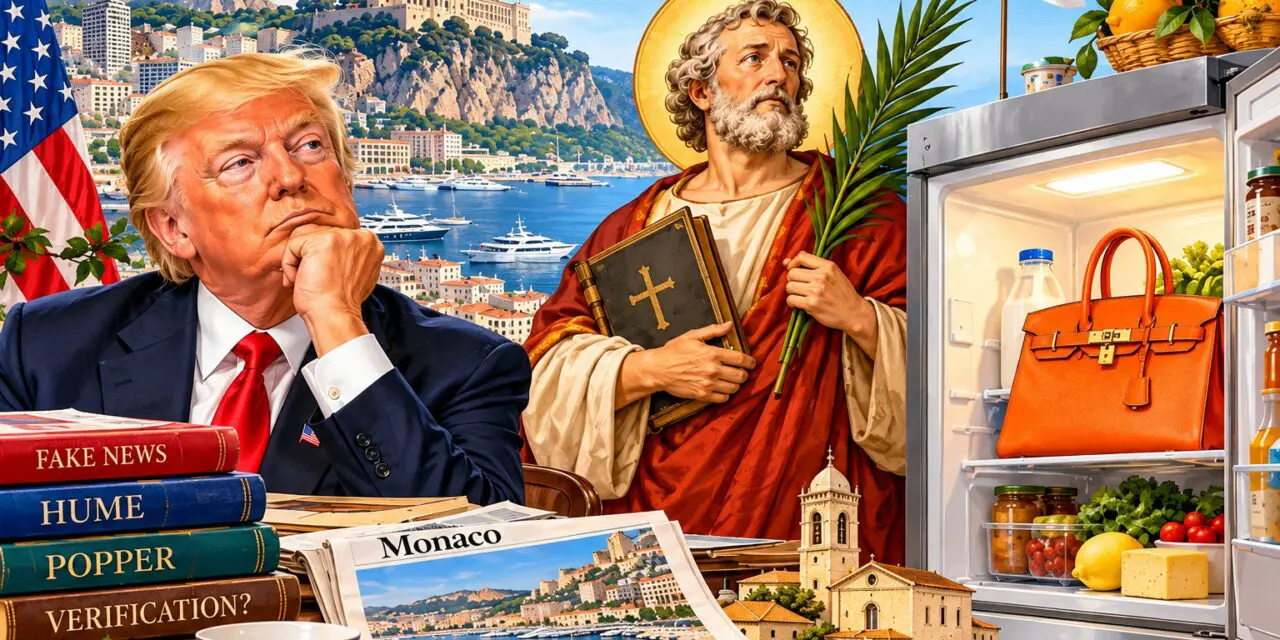
Did Saint Barnabas, companion of Saint Paul, visit Monaco? Tradition says Nice was evangelised by St Barnabas after being sent there by St Paul. Monaco historically belonged within the ecclesiastical sphere of the Diocese of Nice, and a 1078 document links the then chapel of Sainte-Marie at Monaco’s port with the Bishop of Nice…
So there is a link: From Barnabas to the Nice tradition to the Diocese of Nice to Monaco. The missing link is, however, evidence that St Barnabas himself travelled from Nice into the Monaco area. St Barnabas is attested in the Book of Acts. Evidence for his western Mediterranean travels is much less certain. The Ligurian tradition has been described as legendary.
This does not prove St Barnabas stood on the Rock of Monaco, but neither does uncertainty make the tradition untrue.
Good Morning Monaco ☀️
The day’s Monaco news in your inbox every morning. Free, unsubscribe anytime.
🔒 We won’t spam you or sell your data. Changed your mind? Unsubscribe with one click at the bottom of any email.
We live in an age of “FAKE NEWS”, fact-checking and AI. Donald Trump has made “fake news” a familiar daily expression. Establishing truth matters, but a key point to note is that lack of verification is not proof of falsehood. Where does the burden of proof lie? If someone claimed St Barnabas came to Monaco, it is normally their responsibility to provide evidence. What about someone claiming he never came? It raises the question: Can a negative ever be proved?
Some would argue that, of course, it can. There are examples. There are no married bachelors, and no four-sided triangles. These are negatives that are true by definition. If I claim there is no Hermès bag in my fridge, I can open the fridge and inspect it. If it is empty, I have strong grounds for proving that particular negative.
The expectation that claims about reality should be supported by empirical evidence and scientific verification is largely modern. It developed during the Scientific Revolution and after the Enlightenment. Earlier societies were not indifferent to evidence. They used observation, testimony, written records, logic and mathematics. Tradition though could also carry real weight.
Science is extraordinarily powerful, but scientism (the belief that science is the only reliable route to knowledge) can become problematic. Seven plus three equals ten. We can almost demonstrate this with seven apples and three apples, but that does not actually prove the abstract mathematical proposition 7 + 3 = 10; it demonstrates instead that seven apples plus three apples equals ten apples. The mathematical proposition is established through mathematical proof, not scientific verification.
The fact that something cannot be established by scientific verification does not, therefore, make it untrue.
This is why some find the demand for scientific verification problematic when applied to questions such as whether St Barnabas ever visited Monaco. If someone says, “You cannot scientifically prove that he did,” with the inference of “therefore it didn’t happen,” they have confused the absence of one particular kind of verification with proof of falsehood.
Contemporaneous evidence does not automatically mean truth either, though. A document from St Barnabas’s lifetime detailing a trip to Monaco could contain mistakes or lies. Equally, non-contemporaneous does not mean false.
Just because a book about Nero is written today does not mean it is automatically inaccurate simply by virtue of it being modern.
The same applies to St Barnabas.We have a longstanding tradition connecting him with Nice, a documented relationship between Monaco and the Diocese of Nice, and the 1078 record. But we do not have scientific evidence proving that St Barnabas preached in Monaco.
So:
Is there a Hermès bag in my fridge?
No.
Can it be proved?
Yes.
Did St Barnabas come to the Riviera or not?
I don’t know.
Can it be proved either way?
No. But unproven is not the same as disproven.
So I’m happy to believe St Barnabas reached Monaco, unless, of course, someone can verify that the whole thing is fake news. Absence of evidence is not necessarily evidence of absence.
A Se Revede!
References:
Acts of the Apostles, Acts 4:36 and 13–15.
Eusebius, Ecclesiastical History.
Catholic Encyclopedia, “Nice” and “Liguria”.
Persée, “Un bréviaire de Nice du XIVe siècle” — 1078 Monaco chapel/Bishop of Nice record.
Catholic Encyclopedia, “Principality and Diocese of Monaco”.