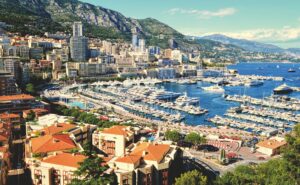
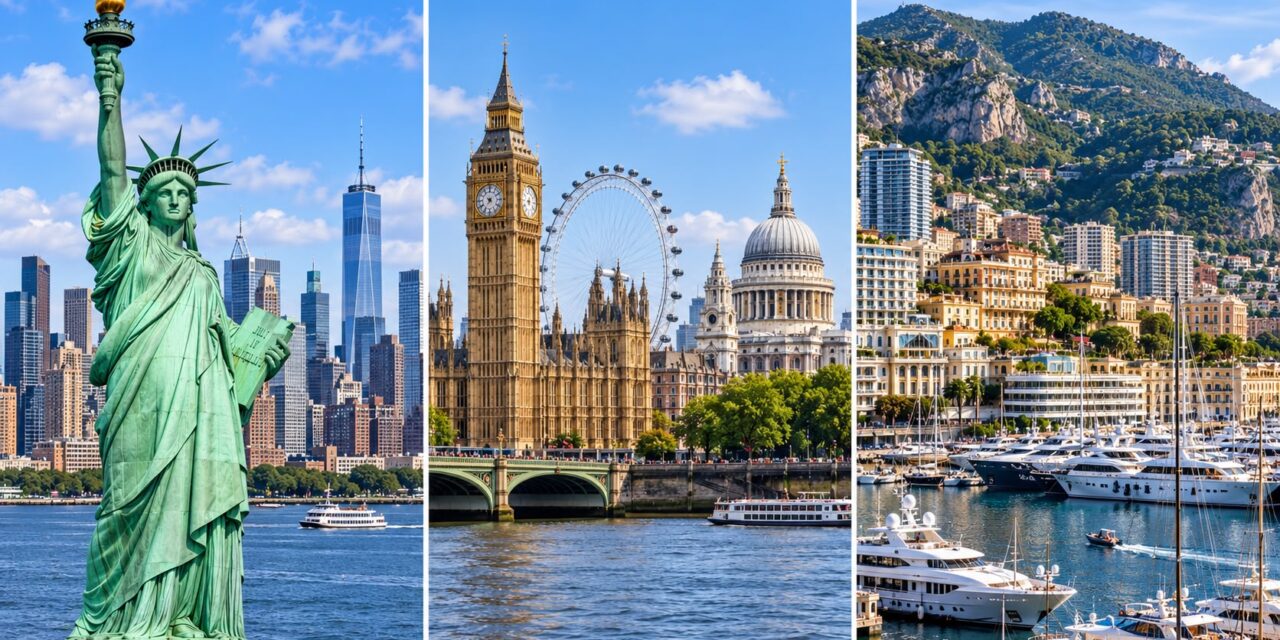
As tax authorities in two of the world’s traditional wealth capitals tighten their grip on second-home owners, Monaco’s long-standing fiscal stability is emerging as an increasingly compelling alternative for the world’s wealthiest buyers.
The Principality’s appeal rests on a simple, well-established formula: no property tax, no capital gains tax, and no annual wealth tax on real estate.
That predictability stands in sharp contrast to what’s now unfolding in New York and London, according to reporting by the Financial Times, where second-home ownership has become markedly more expensive and considerably less certain over the past year.
Good Morning Monaco ☀️
The day’s Monaco news in your inbox every morning. Free, unsubscribe anytime.
🔒 We won’t spam you or sell your data. Changed your mind? Unsubscribe with one click at the bottom of any email.
In New York, a new pied-à-terre tax came into effect on July 1, targeting second homes valued above $5 million on a sliding scale, with brokers estimating annual bills ranging from $40,000 on a $5 million apartment up to $240,000 on a $15 million property.
Realtor John Gomes, who has closed roughly $15 billion in high-value home sales over a 22-year career, told the FT that the combination of rising service charges, existing purchase taxes and now this new levy was becoming genuinely difficult to justify for owners.
London tells a similar story, just through a different mechanism. Stamp duty on high-value international purchases has climbed as high as 19 percent, more than triple the rate buyers faced back in 2010, and the FT reports that agents are increasingly watching promising deals collapse once buyers consult their accountants.
Prime central London property values have fallen 25 percent since 2014, according to Savills, while sales of homes above £7.5 million dropped from 232 in 2024 to just 163 the following year, per Knight Frank. Service charges in London have climbed 75 percent over the past decade alone.
Those pressures are already reshaping buyer behaviour. According to the FT, family office advisors in New York report that a significant share of clients who were previously considering a pied-à-terre purchase have shifted toward renting instead, unwilling to absorb an unpredictable and rising annual tax bill on top of an already expensive purchase.
For buyers weighing a genuine alternative rather than simply scaling back their ambitions, Monaco offers something increasingly hard to find in London or New York: certainty.
Beyond its tax framework, the Principality delivers many of the same qualities that made pieds-à-terre in these gateway cities desirable in the first place, security, discretion, world-class infrastructure and a genuinely international community, without the political volatility currently driving up ownership costs elsewhere.
As New York and London look to high-value second-home owners to help close budget gaps, Monaco’s steady fiscal environment looks less like an outlier and more like precisely the kind of stability today’s global wealth is now searching for.