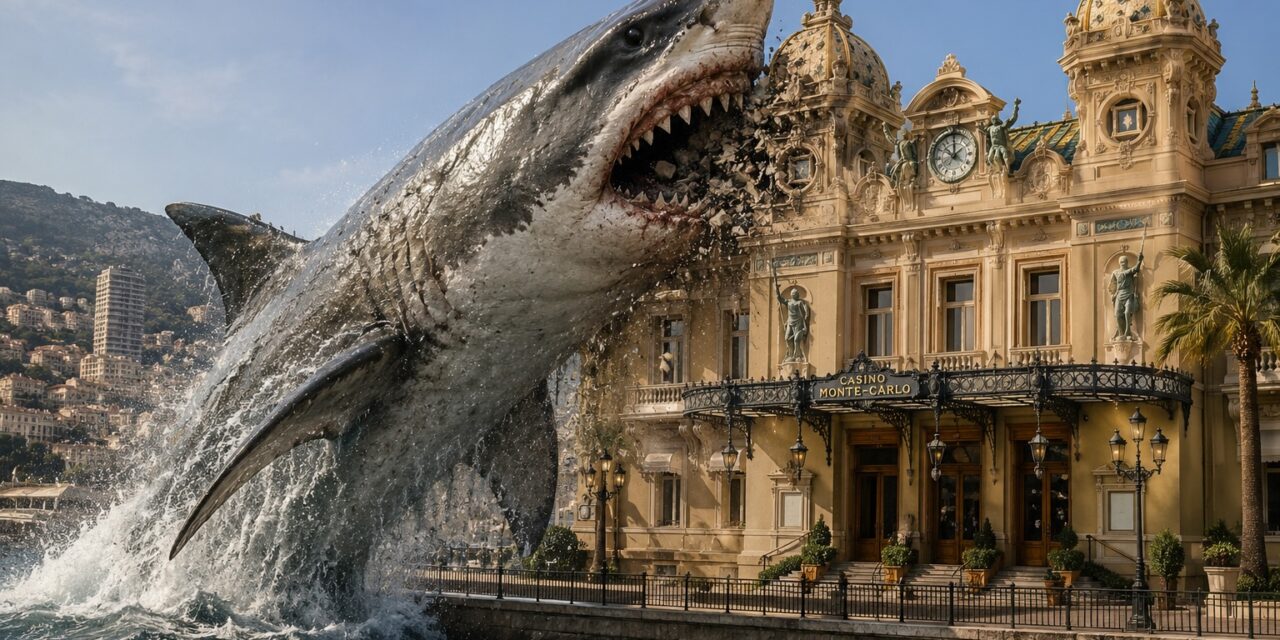
Great white sharks are rare along the French Riviera, and almost completely absent from Monaco waters, however, every so often someone claims to have seen one…
A dark shape moving beneath the surface. A fin cutting through the water. Something large cruising just offshore. On a coastline where the sea is an almost constant backdrop to everyday life, stories of sharks are bound to circulate, and the great white is inevitably the species that springs most readily to mind.
Whilst the claim that a great white has been spotted should be taken seriously, after all there are no underwater borders preventing one from visiting, the chances are that the animal spotted was not a great white. This is not necessarily a deliberate lie but perhaps more likely a case of mistaken identity.
Good Morning Monaco ☀️
The day's Monaco news in your inbox every morning. Free, unsubscribe anytime.
The ocean sunfish (Mola Mola) is one obvious culprit of the mix up. Its tall dorsal fin can protrude above the surface and is a doppelganger for a shark’s fin. Basking sharks can also be mistaken for great whites, despite being harmless plankton feeders, whilst dolphins and other marine animals can create similarly misleading glimpses from a distance.
So, whilst the beaches of Monte Carlo remain clear, genuine and rare scientific sightings do happen nearby in the wider Côte d’Azur and Mediterranean waters. In November 2024, Monaco Life reported the exceptionally rare sighting of a great white shark near the Porquerolles Islands in Port-Cros National Park. The juvenile, estimated at around four metres long, was filmed by a sailor and subsequently identified by French marine experts. The report noted that only around 40 sightings had been documented in the Gulf of Lion since the 17th century.
Historical records indicate that great white sharks were once more numerous and widely distributed in the Mediterranean. Overfishing and the loss of prey are amongst the factors associated with their decline. Scientists welcomed the discovery as evidence that great whites remain in the Mediterranean, although the species is critically endangered in European waters and its population has declined dramatically, suggesting that the waters around Monaco do not constitute anything like a great white habitat.
The French Riviera is one of the busiest coastal areas in the Mediterranean, with intense recreational boating, commercial traffic and extensive coastal development. Port Hercule is an enclosed, swarming, maritime hub surrounded by the bustling streets of the Principality and packed with vessels for much of the year. If great whites were regular visitors, then surely sightings would be more frequent.
For swimmers and boaters, there is little reason to panic. The overwhelming majority of fins seen along the Riviera will probably belong to something other than a great white.
In 2020. Monaco’s Oceanographic Museum identified a blue shark swimming in Menton in extremely shallow water. This was during the Covid lockdown, when there was unusually little human activity along the coast.
Because sharks are rare, dramatic and guaranteed to attract attention, fabricated sightings around Monaco and the Côte d’Azur make particularly effective social-media clickbait, where sensational images and claims can quickly generate views, shares and followers before anyone stops to verify them.
But long before social media discovered the click-generating power of a shark sighting, Hollywood had already learned that few creatures could capture and terrify the public imagination quite like the great white.
And few Hollywood stars can claim a more curious connection to both the sharks of the big screen and the Côte d’Azur than Sir Michael Caine.
In 1988, Caine starred alongside Steve Martin in Dirty Rotten Scoundrels, which was filmed extensively along the Côte d’Azur, including locations around Antibes, Beaulieu-sur-Mer, Cap-Ferrat and Nice. The film’s fictional setting of Beaumont-sur-Mer was created from several Riviera locations.
But his more famous connection with sharks came nowhere near Monaco.
In 1987, Caine appeared in Jaws: The Revenge, the fourth film in the Jaws series. His role was relatively small, but the film produced one of the most enduring anecdotes of his career.
Caine has repeatedly told the story of how he was paid handsomely for the film and used the money to buy a new house. In one interview, he recalled being paid $1 million for two weeks’ work.
When one critic told him that they had seen Jaws: The Revenge and thought it was terrible, Caine’s legendary response was that; whilst he himself hadn’t seen the film yet, he had seen the mansion it had paid for. Now that is a verified sighting!
References
- IUCN, The Conservation Status of Sharks, Rays and Chimaeras in the Mediterranean Sea — regional assessment of Mediterranean sharks, including the threatened status of the region’s shark populations and the impact of overfishing and habitat degradation.
- IUCN report
- Frontiers in Marine Science study
- Smithsonian Ocean, “Mola mola — The Ocean’s Gentle Giant” — explains the ocean sunfish’s distinctive tall dorsal fin and notes that it is often mistaken for a shark when the fin extends above the surface.
- Smithsonian Ocean
- IMDb, Dirty Rotten Scoundrels filming locations — records filming locations including Antibes, Beaulieu-sur-Mer, Saint-Jean-Cap-Ferrat, Nice and Villefranche-sur-Mer.
- IMDb filming locations
- The Irish Times, interview with Michael Caine (2018) — Caine on Jaws: The Revenge.
- Musée Océanographique de Monaco — official website, including visitor information and contact details.
- Musée Océanographique de Monaco official website (https://musee.oceano.org/en?utm_source=chatgpt.com)