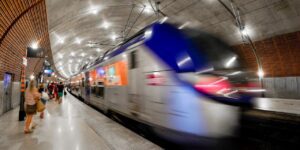

When the last trains leave Monaco Monte-Carlo station each night and the platforms empty, a different kind of operation begins. Teams of railway workers step onto the tracks to carry out a series of upgrades that will gradually transform one of the Riviera’s most important rail links.
The work is part of a wider programme led by SNCF Réseau to modernise the railway line running between Marseille and Ventimiglia. This coastal route stretches roughly 260 kilometres and carries around 270 trains every day, making it one of the busiest rail corridors in southern Europe. The improvements are intended to increase reliability and capacity while preparing the line for the introduction of new signalling technology later in the decade.
Central to the project is the future rollout of the European Rail Traffic Management System, known as ERTMS. This digital signalling platform will allow train movements to be monitored continuously from a control centre in Marseille, helping operators manage traffic more efficiently. Once fully implemented, the system should make it possible to increase the number of services running along the line, with a target of trains passing through Monaco roughly every ten minutes by 2028.
Good Morning Monaco ☀️
The day’s Monaco news in your inbox every morning. Free, unsubscribe anytime.
🔒 We won’t spam you or sell your data. Changed your mind? Unsubscribe with one click at the bottom of any email.
Before that can happen, however, parts of the infrastructure must be replaced. Many of the rails currently in use have been in service for more than three decades. The new rails being installed are stronger, produced with more modern techniques and better suited to the demands of today’s railway traffic.
The current phase of the project focuses on the section between Beaulieu-sur-Mer and Menton, where approximately 40 kilometres of track across two lines are being renewed. Work began earlier this year between Beaulieu and Monaco and is expected to continue through the first half of the year, before moving further east later in the autumn.
At Monaco station itself, the work is carried out during a narrow overnight window once passenger services have finished for the day. Between around 23:00 and 5:00, teams of engineers, safety specialists and subcontractors move in to replace sections of track before the first morning trains arrive.
The process begins with removing the existing rails from the sleepers that support them. Using specialised rail-road machinery capable of moving both on rails and tyres, crews lift out the old sections and position the new ones. One of the most delicate stages of the operation comes when the rails are welded together. Even the slightest misalignment can lead to vibrations or structural fatigue over time, so the work must be carried out with millimetre precision.
Welders align the rails carefully before sealing them in a mould and pouring molten metal to fuse the pieces together. Once the metal cools, the joint is refined and ground smooth so that trains can pass over it seamlessly.
Although the work only takes place for a few hours each night, progress adds up quickly. Teams are able to renew close to a kilometre of track during a typical shift. Over the coming years, these nightly operations will help reshape the infrastructure beneath the line and prepare the Riviera railway network for more frequent and modern train services.