
High above Bormio on the notoriously unforgiving Stelvio slope, Monaco’s Arnaud Alessandria brought his Milan–Cortina Olympic campaign to a close with a determined and composed Super-G performance that carried meaning well beyond the final ranking. Finishing 30th in one of alpine skiing’s most technically demanding disciplines, the Monégasque skier delivered a run defined by commitment and confidence rather than caution.
The morning of Wednesday, February 11 began under heavy cloud cover, with poor visibility casting doubt over whether the race would even proceed. The Stelvio, already regarded as one of the most challenging tracks on the circuit, looked particularly treacherous in flat light. When organisers confirmed the start, conditions remained difficult. The snow had softened and become increasingly rutted as racers passed through, making life especially complicated for those with later start numbers. Alessandria, wearing bib 40, faced a course that was progressively more unpredictable.
Earlier in the week, he had completed the downhill event with a careful and measured approach, finishing just outside the top 30. This time, the mindset was different. From the moment he left the start gate, Alessandria attacked the course with greater freedom. He maintained speed through the technical sections, absorbed the terrain with maturity, and handled the shifting surface with composure. His time of 1:30.13 secured 30th place — a top-30 Olympic finish that holds real value in an elite field separated by fine margins.
At the front of the race, Switzerland’s Franjo von Allmen claimed gold, finishing ahead of American Ryan Cochran-Siegle and compatriot Marco Odermatt. The demanding conditions claimed several high-profile victims, with multiple favourites failing to finish — a reminder of just how unforgiving the Stelvio can be.
For Alessandria, however, the focus was on execution rather than medals. He explained afterwards that his objective had been to ski without holding anything back, and that he felt he had finally managed to deliver a fully committed performance. While acknowledging minor technical imperfections, he expressed satisfaction in having raced without hesitation.
For Monaco’s ski federation, the result represented progression at the highest level of the sport. Competing against the world’s dominant alpine nations, Alessandria showed that Monaco’s presence on the Olympic stage is built on preparation and belief. Months of structured training and collaboration with his coaching team translated into a run that reflected growth and assurance under pressure.
He may not have stepped onto the podium in Bormio, but on one of alpine skiing’s most intimidating slopes, under difficult conditions and Olympic scrutiny, Arnaud Alessandria left with something equally significant: renewed confidence and a clear sense of forward momentum.
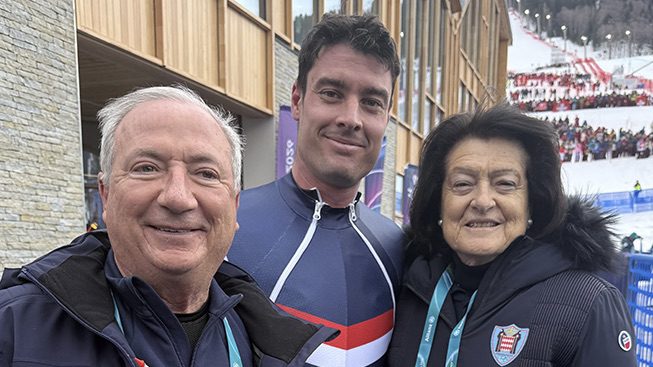
Image courtesy of Stéphan Maggi – Comité olympique monégasque: Arnaud Alessandria alongside Yvette Lambin Berti, Secretary General of the COM, and Philippe Pasquier, President of the Monegasque Ski Federation