
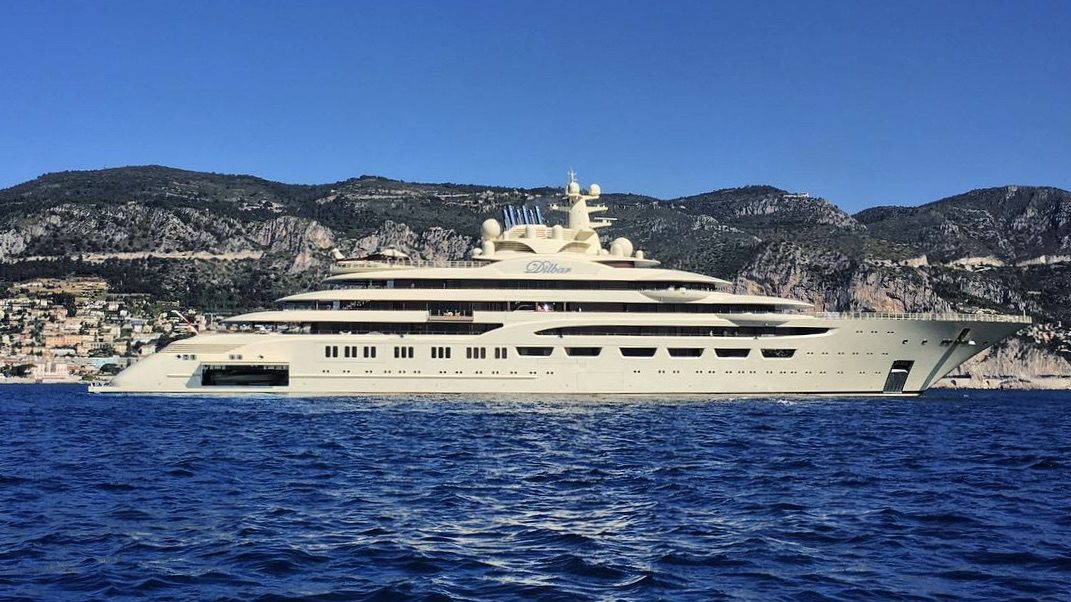
From Monaco to Antibes, the assets of Russian billionaire Alisher Usmanov have been under intense scrutiny since the outbreak of the war in Ukraine — and now a key legal chapter is drawing to a close in Germany. Usmanov is set to see a major investigation dropped after agreeing to pay around €10 million, bringing an end to one of the most closely watched sanctions-related cases involving a Russian oligarch in Europe. Meanwhile, his luxury holdings remain constrained: his helicopters are grounded at Le Castellet and Monaco, and his yacht, Dilbar, normally home ported in Antibes, is currently immobilised in Germany.
German prosecutors confirmed they will terminate proceedings once the full amount has been transferred, following an agreement under which €8.5 million will be paid to the public treasury and a further €1.5 million donated to charitable organisations. The investigation focused on alleged breaches of EU sanctions and suspected money-laundering linked to properties in Bavaria, claims that Usmanov has consistently denied.
Usmanov became a target of European sanctions in the aftermath of Russia’s full-scale invasion of Ukraine in February 2022. The European Union cited his “particularly close ties” to President Vladimir Putin, placing him among the group of Russian business figures subject to asset freezes and strict disclosure requirements across EU member states.
German authorities opened their probe amid concerns that assets linked to Usmanov had not been properly declared, as required under the sanctions regime. In late 2022, police carried out high-profile raids on properties believed to be connected to him, examining ownership structures, security payments and the declaration of high-value items such as artwork, jewellery and wine collections.
Through his legal team, Usmanov has maintained that the allegations were unfounded. His representatives argued that the billionaire had no legal control over the entities cited by prosecutors and that the assets in question could not be attributed to him under EU sanctions law. They also stressed that the payment agreement does not amount to an admission of guilt, a point not disputed by prosecutors.
The case will be closed under a legal mechanism in German law that allows investigations to be suspended without trial in complex financial matters. For Usmanov, the outcome avoids a lengthy and reputationally damaging court battle. For prosecutors, it brings closure to a case marked by contested ownership claims and cross-border financial structures.
While the investigation is ending, the broader debate over sanctions enforcement remains unresolved. The Usmanov case highlights both the determination of European authorities to pursue high-profile figures and the practical difficulties of proving violations when wealth is held through family members, trusts and offshore arrangements — challenges that continue to test the credibility and reach of Europe’s sanctions regime.
Image courtesy of @rourebel: Alisher Usmanov’s yacht Dilbar anchored by Monaco