
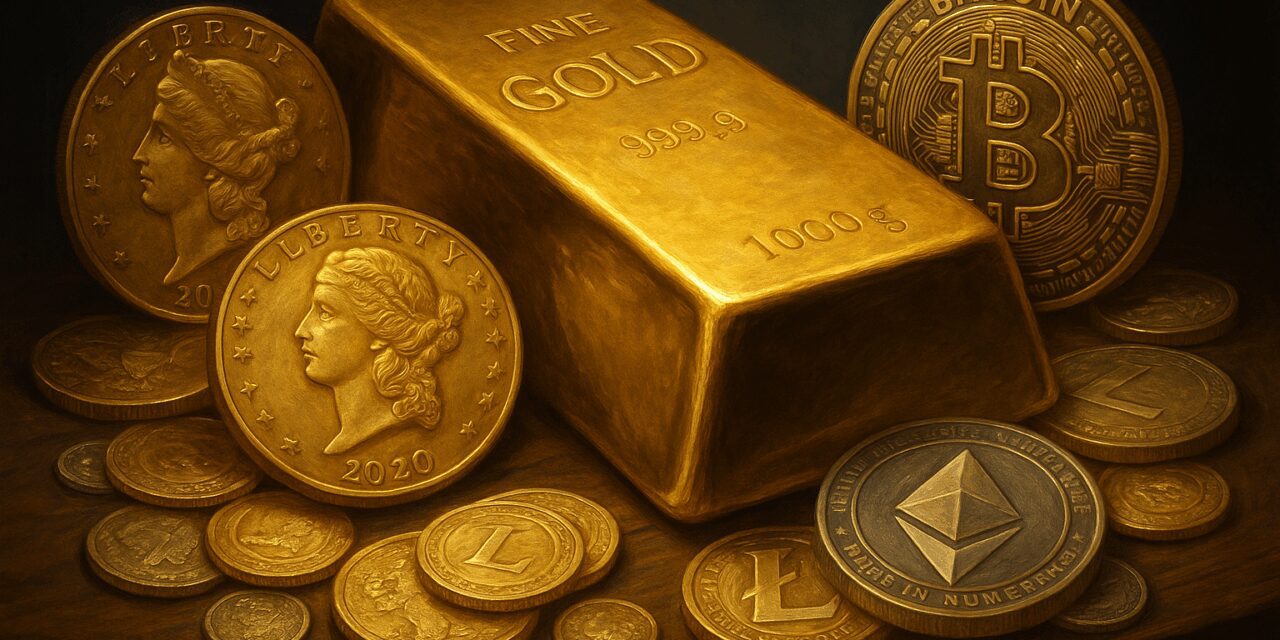
In this fourth and final instalment of his series on currency, Patrick Laure turns his attention to cryptocurrency, cutting through the hype to examine whether it represents a new form of value, or simply the latest grand financial illusion. (Read parts one, two and three here first)…
The reality of cryptocurrency as a force of representation and illusion.
Money, currency, cannot be bought, it must be earned.
Moreover, you don’t buy cryptocurrency with cryptocurrency; initially, you buy cryptocurrency with pounds sterling, dollars, euros, yen, etc. Cryptocurrency is to currency what Canada Dry is to alcohol. It only has the taste, but without the intoxication. The only intoxication cryptocurrency provides is the belief that you can make a profit on it. However, you don’t buy euros to make a profit on them; you earn euros or any other currency through the fruits of your labour. It’s not the same thing. Of course, we can potentially make money on currency, but that’s currency trading. This gain is often marginal, except for large positions taken by major financiers (George Soros, to name but one).
However, most currency investments are made through structured, synthetic products and are used for hedging on the capital markets, as currency operators are involved in the trade and exchange of goods or commodities. Wealth creation therefore comes from goods and commodities, which precede and determine the value of currency, and not the other way around. Currency hedging is merely the consequence of wealth creation that is exogenous to currency. As a result, cryptocurrency does not create any wealth; it is purely speculative in that its value is determined solely by the beliefs of those who buy it.
Cryptocurrency is therefore a ‘currency’ in name only; it is in fact a financial product, a company that may or may not be listed on the stock exchange, a Rolex Daytona that was bought for €5,000 in 1995 and resold for €100,000 in 2020 because the buyer had a keen eye, or simply because its value exceeded what the buyer had set out to spend on a watch.
Cryptocurrency in the Principality of Monaco
In the Principality of Monaco, cryptocurrency is treated in the same way as in all other countries around the world, meaning that only the tax aspects of the transaction (purchase/sale) are decisive and worth knowing about. In fact, you only need to look at what is said when the question is asked on the web:
“Cryptocurrencies first appeared in 2008, and since then they have brought about many changes in the financial world. Due to their relatively recent nature, it has taken some time for government regulations surrounding cryptocurrencies to become clear.
However, the tax authorities have now developed relatively clear regulations on the subject, making it possible to determine in a more predictable manner which taxes apply to digital currencies.”
Clearly, cryptocurrencies are analysed solely from a tax perspective, and for good reason: they are only a product, an investment, and in no way a ‘currency’ that is sufficient in itself.
For if currency expressed in capital is subject to tax (that of the weight of assets, our own or a foreign currency), we do not have a tax on the valuation of our currency, nor a tax reversal in the event of inflation or loss of value of our currency (deflation).
If, by some extraordinary chance, we did have a ‘tax rebate’ in the event of inflation or deflation, we would know about it. And governments would strive to achieve a balanced budget (so as not to have to reimburse taxpayers), but this is not the case.
Thus, cryptocurrency, like a share on the stock market, is taxed on capital gains, which shows how much its ‘exchange’ function is a figment of the imagination, and in no way a primary function of utility. As for the value of a cryptocurrency itself, it depends on belief in its growth, but less on its hypothetical counterpart. Is this even necessary?
Finally, in legal terms, the only reality that can exist between the holder of a cryptocurrency and the Principality of Monaco would be the origin of the purchase. If the purchase was made on the basis of a recommendation, it would suffice to analyse the terms of the recommendation in terms of advice and management between the holder of the cryptocurrency and its custodian.
Dutch tulips
The history of Dutch tulips shows that belief is important, but in no way did tulips have any value other than their intrinsic beauty. ‘Tulip mania’ took place from 1634 to 1637. It was the first financial ‘bubble’. An unreasonable belief in a symbol of wealth and prestige. It demonstrated the irrationality of financial markets, which from the 17th to the 21st century does not seem to have disappeared, and why should it?
While comparisons are not always valid, the similarity between cryptocurrency and Dutch tulips lies in the fact that both are misaligned between their real value and their market value, to such an extent that in pursuit of real value, Bitcoin is now correlated with physical gold.
The correlation between the price of gold and Bitcoin
It is interesting to note the correlation between the rise in the price of gold in recent years and that of cryptocurrency, particularly Bitcoin.
This correlation has been observed since 2020 and seems to be accelerating, reaching 0.85 today. Many explanations have been put forward to define this phenomenon, but beyond the explanations and analyses, one simple observation stands out.
The Bitcoin phenomenon is leading operators to buy gold, precisely in order to create a counterpart to it, and as such, it contrasts a millennial pillar of safe-haven value, which is gold, with a digital outsider.
Could cryptocurrency become digital gold, and if so, why buy digital gold when physical gold gives the same thrill?
Patrick LAURE
Secrétaire Particulier
+33 6 35 45 27 02
laurepatrick@wanadoo.fr
**The information provided in this article is for general informational purposes only and does not constitute legal advice. It is not intended to create an attorney-client relationship. Laws and regulations vary by jurisdiction and may change over time. Readers should consult a qualified legal professional for advice specific to their situation. The author and publisher are not responsible for any actions taken based on this information.